Guides
How to Get Coffee Stains Out of Fabric
Tannins, milk and heat decide whether a spill rinses out or becomes a permanent mark. What to do in the first minute, and what to do three days later.
Guides7 min readUpdated October 15, 2026
Guides
Tannins, milk and heat decide whether a spill rinses out or becomes a permanent mark. What to do in the first minute, and what to do three days later.
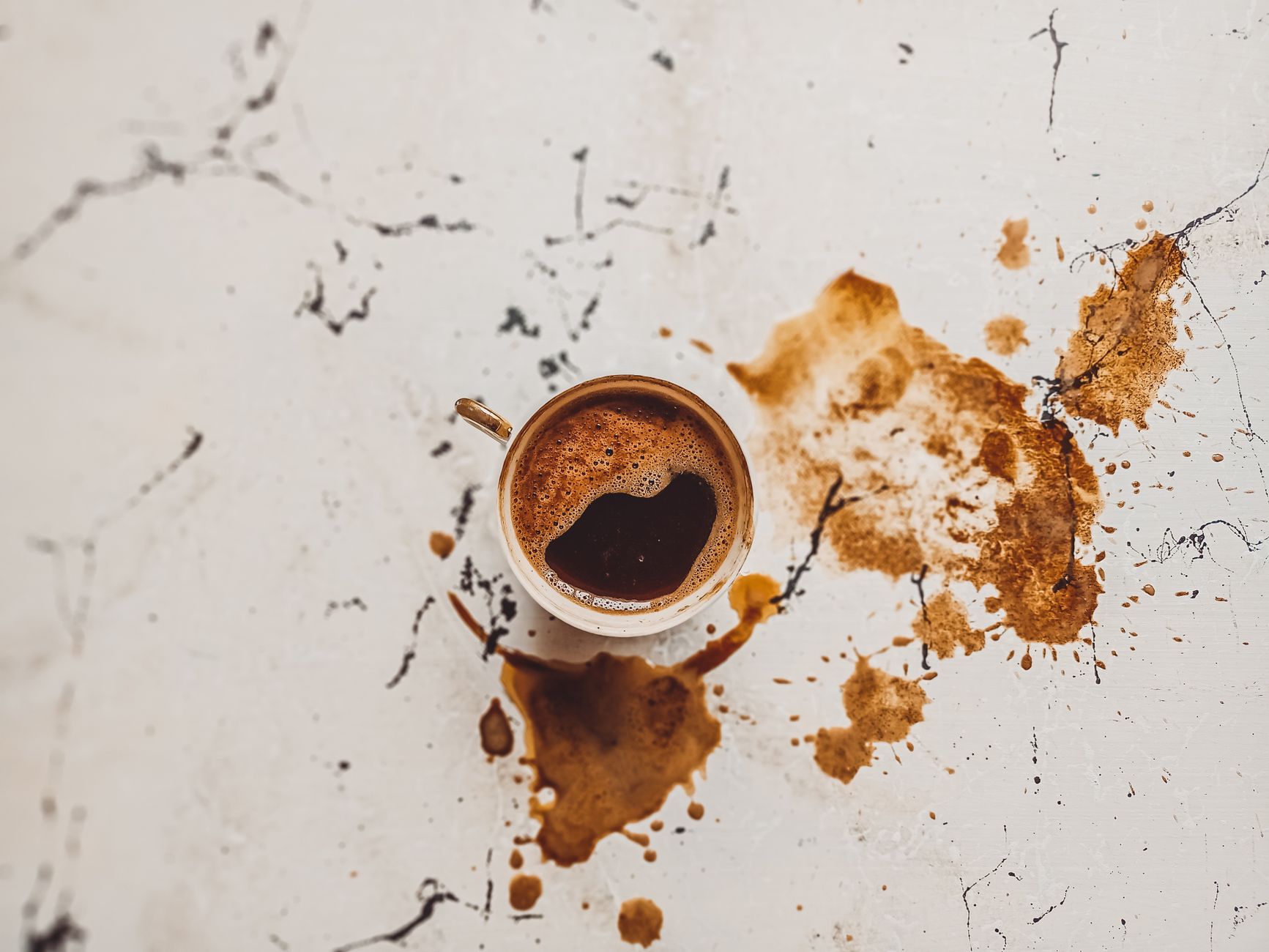
A coffee spill is not dirt sitting on fabric. It is dye. The same tannins and pigments that give a cup its color bond to textile fibers almost immediately, and they bond harder every minute they are left alone, especially if heat arrives before water does. That is why the same spill rinses out of one shirt and ruins another.
What follows is the sequence worth remembering: what to do in the first minute, how to treat a stain that has already dried, and where home remedies should stop and a professional should start.
Coffee carries two things that matter to fabric. Tannins are natural compounds that behave like weak dyes, and they attach to cellulose fibers such as cotton and linen as easily as to protein fibers such as wool and silk. While the spill is wet, that bond can still be broken. Once the liquid dries, the residue oxidizes and locks into the weave, and heat speeds up the whole process.
What is in the cup makes it worse. Milk contains proteins that set and glue pigment to the fibers. Sugar leaves a sticky film that holds the darkest particles in place and gathers dust afterwards. A splash of plain filter coffee is a much smaller problem than a sweet latte, which is why the order of treatment matters more than the product you choose.
Speed is the single most useful factor. Most coffee stains that become permanent were never difficult. They were simply left to dry.
If you are nowhere near a sink, blot with whatever water is available, sparkling water works, and deal with it properly as soon as you can. A damp stain is still recoverable. A dried one takes real work.
Almost every ruined garment shares one of four causes, and each is easy to avoid once it is named.
Blot, do not rub: friction spreads pigment and turns a spot into a halo.
None of these is fatal on its own if you catch it early. Together they add up fast.
For washable garments, the workable approach is a mild acid to loosen the tannin bond, a soap to lift pigment, and patience in between. White vinegar and dish detergent remain the most dependable pairing in a normal kitchen cupboard.
Mix one tablespoon of dish detergent with one tablespoon of white vinegar in two cups of warm water. Apply it to the stain, leave it for ten minutes, then rinse with cold water. Repeat before washing rather than afterwards: the machine is the final step, not the first.
| Treatment | Best suited to | Caution |
|---|---|---|
| Vinegar and dish detergent | Cotton, linen, denim, most blends | Dilute for silk and wool, and always rinse |
| Salt and lemon juice | White cotton only | Citric acid can bleach color fabric |
| Bicarbonate paste | Recent stains, sturdy weaves | Wet the fabric first; do not scrub dry powder into the weave |
| Hydrogen peroxide | White cotton and stubborn marks | Fifteen minutes maximum, and never on color |
For silk, wool and anything labeled dry clean only, dilute a spoonful of vinegar in cold water and blot. Do not scrub delicate fibers, and do not leave a treatment on for hours. If the garment is valuable, a professional clean costs less than replacing it.
Carpet and upholstery behave differently from clothing. Liquid travels sideways through a thick backing and sinks downward, so the visible mark is usually smaller than the actual spill. Blot straight down with a clean cloth and resist the urge to scrub.
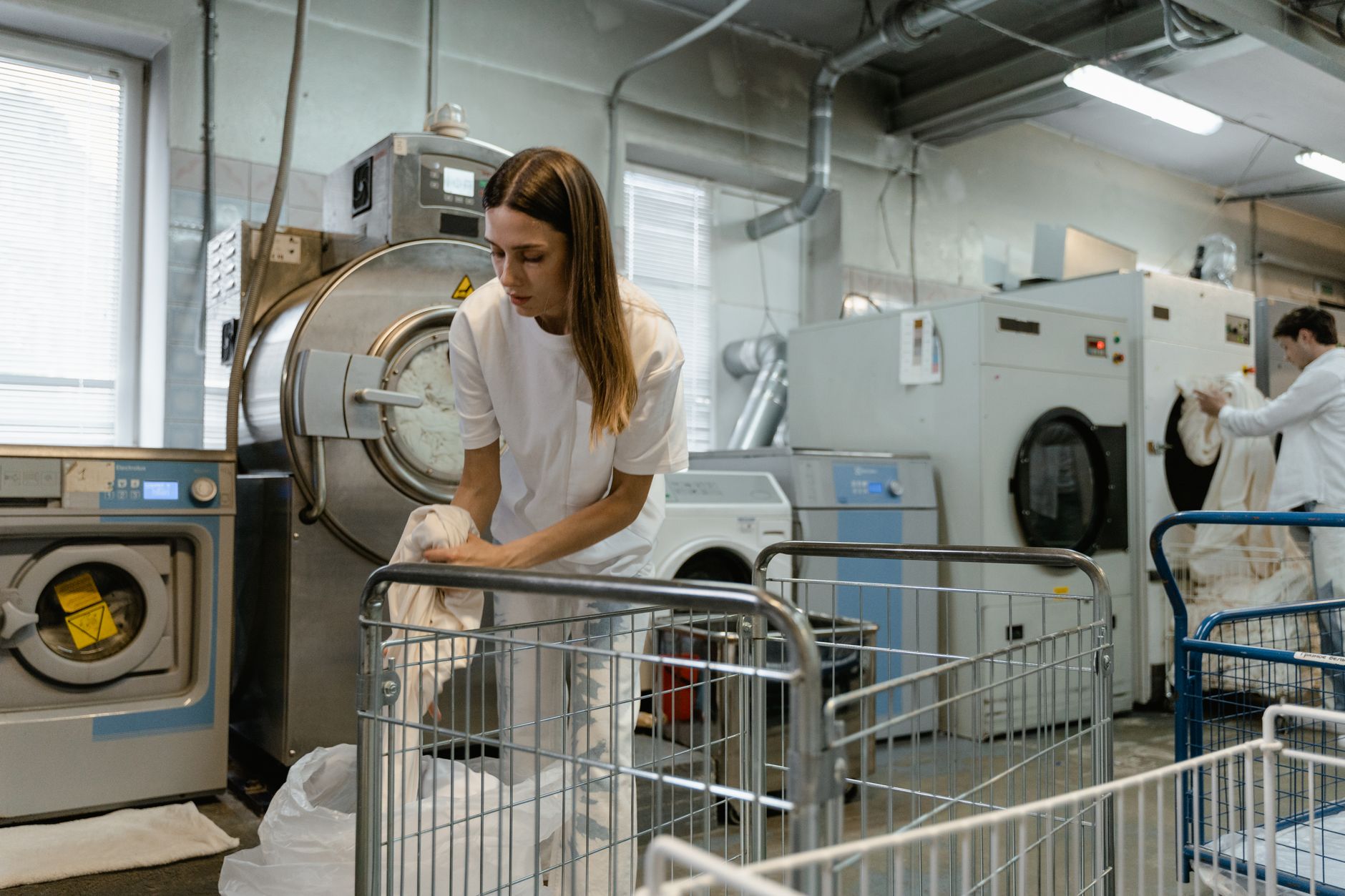
The machine is the last step, not the first.
For carpet, the same vinegar and detergent solution works well. Apply it with a clean cloth and work from the outside of the stain toward the center, which prevents a dark ring forming at the edge. Blot, rinse with cold water, then dry the area right away with a towel to avoid odor and mildew.
For sofas and chairs, keep everything drier. Whip a mild dish soap into a light foam with warm water, apply only the foam, and lift it with a damp cloth. Excess water travels into the padding, where it lingers and creates problems that have nothing to do with coffee.
Call a professional when the stain is large, when the fabric is silk, velvet, wool or antique, or when the piece is valuable enough that a home experiment would be an expensive risk. Injection extraction equipment does in minutes what a cloth cannot do at all.
Dried stains need chemistry and patience rather than force. An overnight soak in an enzyme detergent, with an oxygen based bleach where the care label allows, breaks down residue that surface treatment cannot reach. Follow the soaking temperature printed on the product: enzyme formulas are built for specific ranges, and hotter is not automatically better.
For white cotton, diluted chlorine bleach is a last resort, applied sparingly, well diluted, and never left unattended. For everything else, sunlight is the gentler answer. After washing, hang the damp garment in direct sun for a few hours and the ultraviolet light fades remaining pigment gradually, without stripping color the way a chemical bleach does.
One rule carries more weight than any product: never dry or iron a stain you can still see. Heat fixes it, and the second attempt becomes far harder than the first.
Purpose built stain removers exist for a reason. Coffee is a specific chemistry, and a product made for tannin and pigment will outperform general purpose soap. Choose a color safe version when the fabric is not white, test it on an inside hem or hidden seam, and respect the dwell time on the label rather than extending it for good measure.
Oxygen based powders and enzyme detergents are usually the better supermarket choice: effective on coffee, safer across more fabrics than chlorine, and more forgiving of impatience. Whatever you use, treat first, rinse, check in daylight, then wash. A stain remover that goes straight into the machine with the garment rarely gets the chance to do its job.
Most spills are preventable at no cost. A lidded travel mug for the commute, a little distance between cup and table edge, and a mat wherever coffee is actually drunk all lower the odds. Coffee belongs on stable surfaces, and the deeper you are in a work session, the more that matters.
When a stain does win, the garment does not have to become waste. Old cotton shirts cut into squares make excellent rags for dust, oil and workshop duty, where discoloration is irrelevant. Heavier cotton can be patched, overdyed or cut into something else entirely. It is a small habit, and it turns a ruined shirt into a useful object rather than landfill.
Usually, though it takes more effort. Rewet the area with cold water, work in a color safe stain remover, diluted vinegar or a bicarbonate paste, and let it sit before washing. Stains that also contained milk or sugar often need two or three rounds.
Cold for the first treatment, always. Cold keeps tannins from setting and stops milk proteins from thickening. Hot water has a place in an enzyme soak for some fabrics, but only later, and only if the care label allows it.
Skip the scrubbing and the strong products. Blot with cold water and a little very diluted vinegar or mild soap, then stop. Silk, wool and antique fabrics are jobs for a professional cleaner.
Some do. Diluted vinegar and mild detergent are usually safe, while lemon juice, hydrogen peroxide and chlorine bleach are not. Test any treatment on a hidden area first, and keep chlorine away from color entirely.
Do not put it in the dryer and do not iron it. Heat will fix the remaining mark permanently. Repeat the treatment, give it more time, and only use heat once the fabric looks clean in daylight.