Castle & palace · Barcelona
Palau Meca
DirectionsIts courtyard contains a monumental baroque stair resting on a lowered arch, beneath which survives a medieval semicircular arch once possibly linked to storage rooms or a stable.
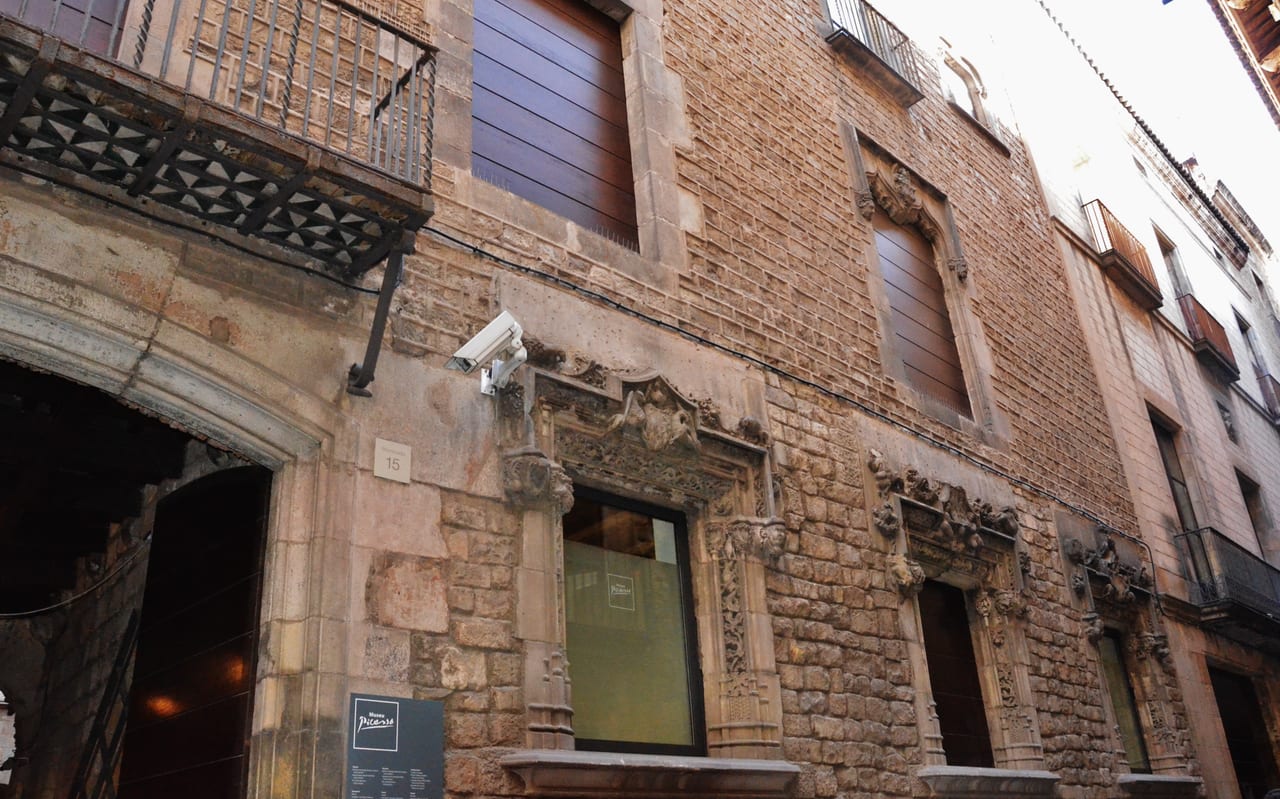
Palau Meca’s documented history begins in 1349, when the property was sold to the moneychanger Jaume Cavaller. It passed through the families of Desplà, Cervelló, Mur, Torralba, Santjust and Caçador before Frederic Meca inherited it in 1653. In 1719, after much of the building had been destroyed during the siege of 1713–1714, Segimon Milans bought the remainder and began a substantial rebuilding, continued by his son Bonaventura. The house has a ground floor, three upper storeys, an attic and a roof terrace. Its façade combines banded ashlar masonry with carefully cut stone surrounds, individual balconies and a cornice; the entrance is a moulded, lowered arch with a scroll-shaped keystone. Inside, some first-floor rooms retain medieval wooden coffered ceilings with traces of polychromy, while others bear nineteenth-century painted schemes of landscapes, cherubs, medallions, musical instruments and garlands. The building became a Mont de Pietat in 1901, later part of the Casa de Famílies de Santa Madrona. After its closure in the early 1970s, it was transferred for the Museu Picasso’s expansion, inaugurated in 1982. Ownership passed definitively to Barcelona City Council in 2011.
At a glance
- Style
- baroque architecture
- Heritage
- Cultural Asset of Local Interest
Ways to explore Palau Meca
Read the façade from ground level upward: note the offset entrance, timber-linteled openings, tightly aligned upper windows and the different balcony projections. In the interior, look for the noble-floor doorway with its former niche and semicircular pediment, the oval windows opening onto the patio, and the eighteenth-century water downpipe resting on a relief shell. Allow time to compare the medieval and nineteenth-century ceiling treatments.
Places to stay near Palau Meca

Live availability and prices from Stay22's partners, refreshed periodically and subject to change. Booking through these links may earn us a commission at no extra cost to you. See our privacy policy.
Cafés near Palau Meca
Cafés near Palau Meca loads as you scroll.
Attractions nearby
Attractions near Palau Meca loads as you scroll.
Cities nearby
Cities nearby loads as you scroll.
More in Barcelona
See more of Barcelona.
Find great cafés, places to stay and other interesting places to visit in Barcelona.