Church · Barcelona
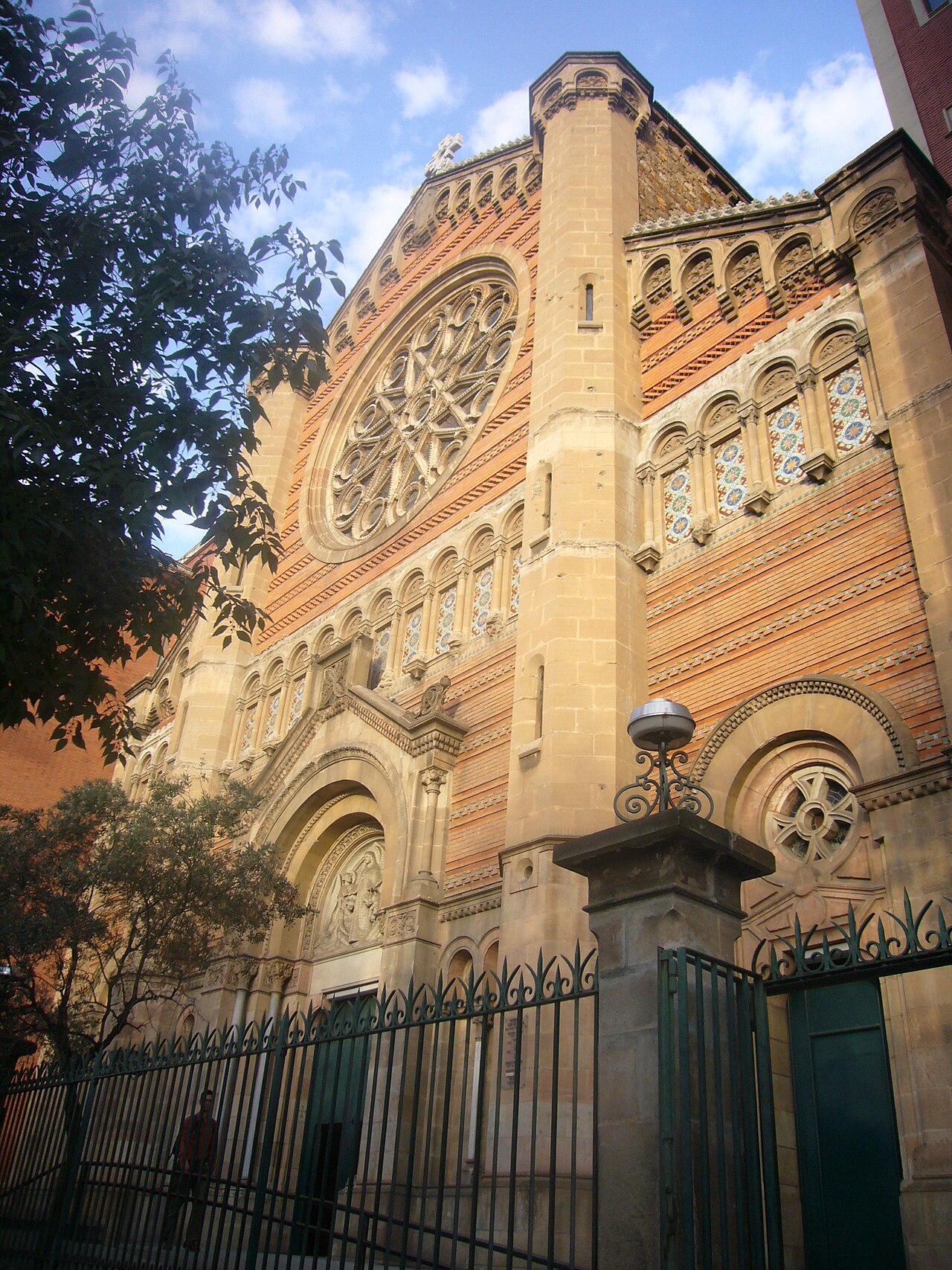
Its façade retains unrepaired cannon and bullet marks from the Spanish Civil War, leaving a visible historical record on the building rather than smoothing it away.
Construction began on 7 April 1904, the fiftieth anniversary of the creation of the dogma of the Immaculate Conception of Mary. Claretian Joan Melé commissioned Joan Martorell i Montells; after Martorell’s death in 1906, his grandnephew Bernardí Martorell i Puig continued the work. The unfinished building was burned during the Tragic Week of 1909, yet construction resumed and the temple opened in 1913 as the Claretians’ chapel, beside their residence and school. Its basilical plan, transept and crossing dome give the interior a commanding structure, while the overall design combines Neo-Byzantine, Romanesque and Mudejar elements rather than following Martorell’s more familiar Neo-Gothic direction. The dome was constructed in 1941 by Joan Bergós i Massó. After wartime use as a vehicle-repair workshop and warehouse, the church was reconstructed and consecrated in 1940. Jaume Clotet i Fabrés, co-founder of the Claretians, was reinterred here in 1960. The sanctuary became a parish in 1972 and is recognized as part of Catalonia’s cultural heritage.
Spend time with the main façade: three vertical axes are separated by sharply cut octagonal stone towers. Note the frieze of blind windows, pierced rose window, crested cornice, central cross and lower round-arched openings. Inside, seek the Rius sculpture of the Immaculate Heart of Mary, compare the founders’ chapel with the Holy Christ chapel, and look into the apse for stained glass, paintings and vault mosaics. The rectangular, white-rendered belltower makes a conspicuous contrast.
Live availability and prices from Stay22's partners, refreshed periodically and subject to change. Booking through these links may earn us a commission at no extra cost to you. See our privacy policy.
More in Barcelona
Find great cafés, places to stay and other interesting places to visit in Barcelona.
