Monument · Barcelona
Cascada Monumental
DirectionsFour water-spouting griffins by Rafael Atché animate the monument’s lower level, amid an exuberant sculptural programme devoted largely to aquatic imagery and mythological birth.
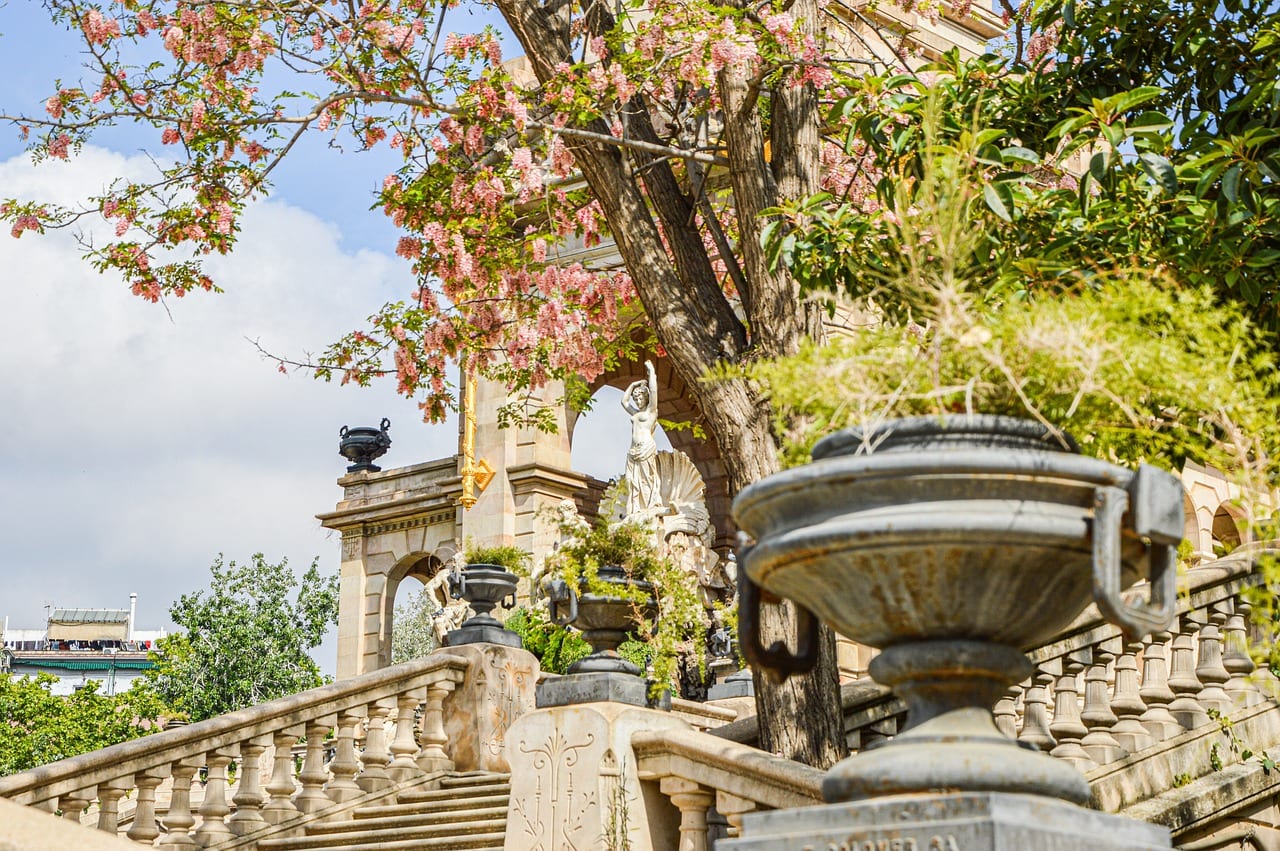
Construction began in 1875 to Josep Fontserè i Mestre’s design. He first envisaged a modest cascade backed by a reservoir supplying the park’s two lakes and fountains, then enlarged it into a monumental composition, perhaps at the urging of the Ciutadella commission. Fontserè drew inspiration from the Château d’Eau at Marseille’s Palais Longchamps. Antoni Gaudí, still an architecture student, prepared the hydraulic project and designed an artificial grotto beneath the ensemble. The monument was inaugurated on 12 June 1881 without its sculptural ornament, which was added in 1888. The decoration brought together work by Rossend Nobas, Venanci Vallmitjana, Eduard B. Its scale, misalignment with Avinguda Meridiana and weak integration with the upper nineteenth-century garden drew criticism, as did the sculptures’ proportions, execution and loosely unified iconographic programme. The work underwent restorations in 1956, 1972, 1989 and 2009, and is recognised as a Cultural Asset of Local Interest.
At a glance
- Built
- 1875
- Style
- Neoclassical architecture
- Heritage
- Cultural Asset of Local Interest
Ways to explore Cascada Monumental
Walk around the lower pool and compare the two water levels with the central triumphal-arch composition, side pavilions and stairways. At the entrance, inspect the two relief medallions bearing lizards, attributed to Gaudí. Look closely at Rossend Nobas’s wrought-iron Quadriga de l’Aurora, Venanci Vallmitjana’s Naixement de Venus and the works by Josep Gamot, Manuel Fuxà and Joan Flotats. The rear grotto and former reservoir, later used as an aquarium, are not open to visitors.
Places to stay near Cascada Monumental

Live availability and prices from Stay22's partners, refreshed periodically and subject to change. Booking through these links may earn us a commission at no extra cost to you. See our privacy policy.
Cafés near Cascada Monumental
Cafés near Cascada Monumental loads as you scroll.
Attractions nearby
Attractions near Cascada Monumental loads as you scroll.
Cities nearby
Cities nearby loads as you scroll.
More in Barcelona
See more of Barcelona.
Find great cafés, places to stay and other interesting places to visit in Barcelona.