Church · Rome
Sant'Andrea al Quirinale
DirectionsThe main altarpiece is illuminated by a concealed light source, a theatrical device that turns the small Baroque interior into a staged revelation.
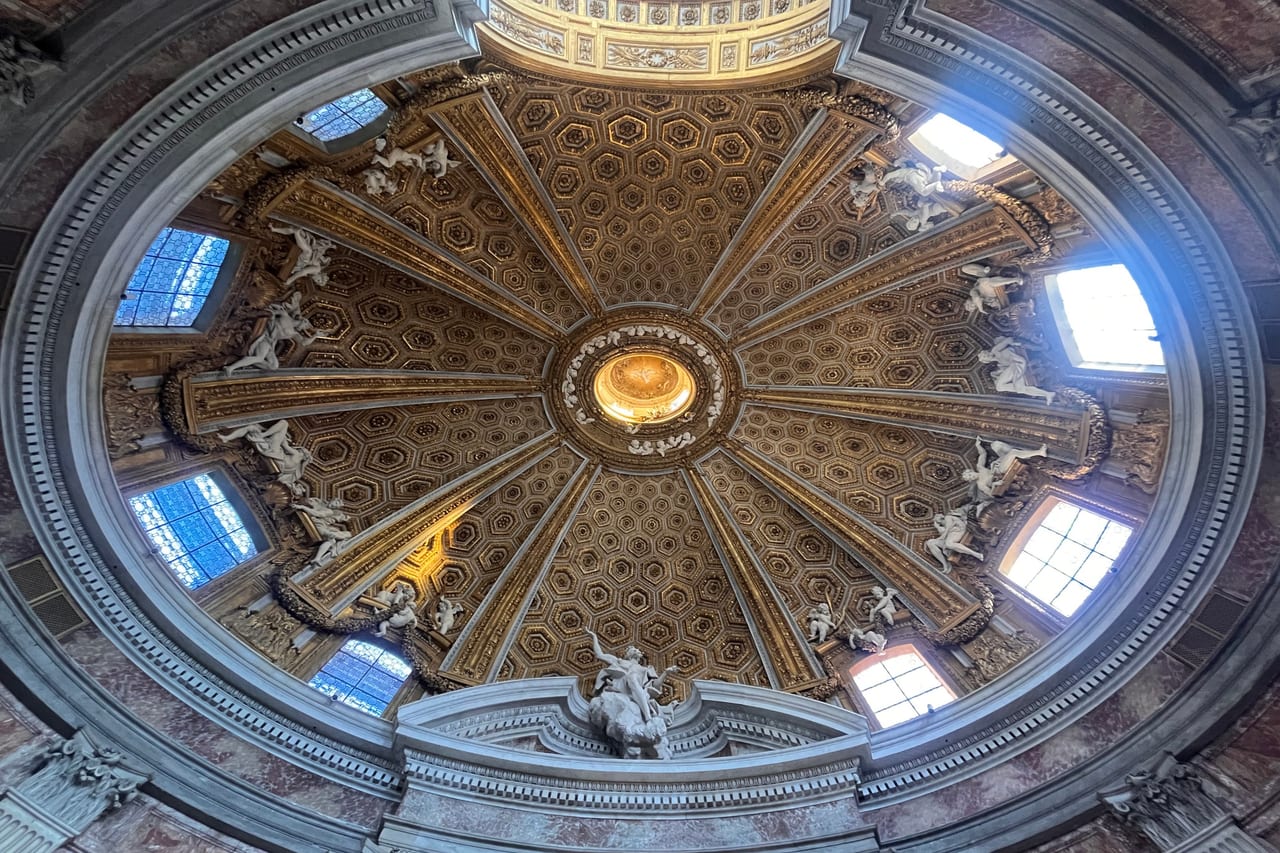
Sant’Andrea al Quirinale was built between 1658 and 1670 as the chapel of the Jesuit novitiate adjoining the Quirinal Palace. Gian Lorenzo Bernini designed it for Pope Alexander VII and Cardinal Camillo Pamphili, nephew of Innocent X. It replaced an earlier Sant’Andrea a Montecavallo, established for the Jesuit novitiate in the second half of the sixteenth century at the direction of Father General Francesco Borgia. The church compresses a remarkably expansive Baroque composition into a small footprint. Its central elliptical plan has a transverse major axis, while the entrance façade is framed by two concave wings, a semicircular stair and an Ionic-columned portico bearing the Pamphili arms. The lateral apses act as structural supports rather than chapels, directing attention toward the principal altar. Gold coffers decorate the small dome, and the walls are clad in richly varied marble. The 1889 widening of Via del Quirinale reduced the embracing wings and lowered the street level by about one metre, prompting the addition of seven stair steps. Carlo Emanuele IV, king of Sardinia, is buried inside.
At a glance
- Built
- 1660
- Architect
- Gian Lorenzo Bernini
- Style
- baroque architecture
- Heritage
- Italian national heritage
Ways to explore Sant'Andrea al Quirinale
Stand in the small forecourt to read the façade’s concave wings and semicircular stair as a spatial composition. Inside, inspect the gold-coffered dome and varied marble, then look for Guillaume Courtois’s Martyrdom of Saint Andrew and Baciccio’s paintings. Giacinto Brandi’s 1675–76 Lamentation over the Dead Christ and companion scenes occupy the right chapel. The adjoining rooms contain Pierre Legros’s dying Saint Stanislaus Kostka. Near the entrance, the 1938 Mascioni organ has two 58-note keyboards, a 30-note pedalboard and 14 stops.
Places to stay near Sant'Andrea al Quirinale

Live availability and prices from Stay22's partners, refreshed periodically and subject to change. Booking through these links may earn us a commission at no extra cost to you. See our privacy policy.
Cafés near Sant'Andrea al Quirinale
Cafés near Sant'Andrea al Quirinale loads as you scroll.
Attractions nearby
Attractions near Sant'Andrea al Quirinale loads as you scroll.
Cities nearby
Cities nearby loads as you scroll.
More in Rome
See more of Rome.
Find great cafés, places to stay and other interesting places to visit in Rome.