Ancient site · Rome
Gemonian stairs
DirectionsThe Gemonian Stairs became Rome’s infamous “Stairs of Mourning,” where condemned bodies were left exposed to the Forum before being cast into the Tiber.
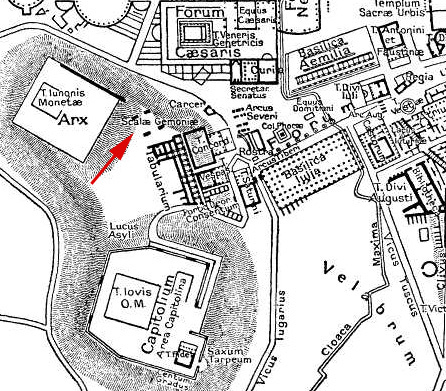
The Scalae Gemoniae were built sometime before Tiberius’ rule, though no ancient text earlier than his reign names them. They descended from the Arx of the Capitoline Hill towards the Roman Forum, running beside the Tabularium and Temple of Concord, with the Mamertine Prison on the opposite side. Their association with execution grew during the later years of Tiberius, amid the emperor’s reputed paranoia. The condemned were generally strangled, then bound and abused; the staircase became a deliberately public stage for disgrace. Lucius Aelius Sejanus, Tiberius’ former Praetorian prefect, was executed after being implicated in a conspiracy in AD 31, and his children followed him there. In AD 69, Vitellius was dragged to the stairs after Vespasian’s forces entered Rome; the defeated emperor reportedly said, “Yet I was once your Emperor.” In AD 106, Decebalus’ head and right hand were thrown there. During the Republic, the Tarpeian Rock had served a comparable purpose. The stairs’ position is thought to correspond roughly with today’s Via di San Pietro in Carcere.
Ways to explore Gemonian stairs
Trace the probable line of the staircase along Via di San Pietro in Carcere, then compare its setting with the surviving Mamertine Prison. From the Forum side, look towards the Tabularium and the Temple of Concord to understand how the route was framed by Rome’s civic and religious monuments. The site is best approached as a topographical investigation: follow the change in level between the Capitoline heights and the Forum, rather than expecting a complete surviving stairway.
Places to stay near Gemonian stairs

Live availability and prices from Stay22's partners, refreshed periodically and subject to change. Booking through these links may earn us a commission at no extra cost to you. See our privacy policy.
Cafés near Gemonian stairs
Cafés near Gemonian stairs loads as you scroll.
Attractions nearby
Attractions near Gemonian stairs loads as you scroll.
Cities nearby
Cities nearby loads as you scroll.
More in Rome
See more of Rome.
Find great cafés, places to stay and other interesting places to visit in Rome.