Ancient site · Rome
Comitium
DirectionsThe Comitium was Rome’s original open-air political meeting place, where assemblies, courts and speeches gathered beside the Senate house and where the Lapis Niger emerged in modern excavations.
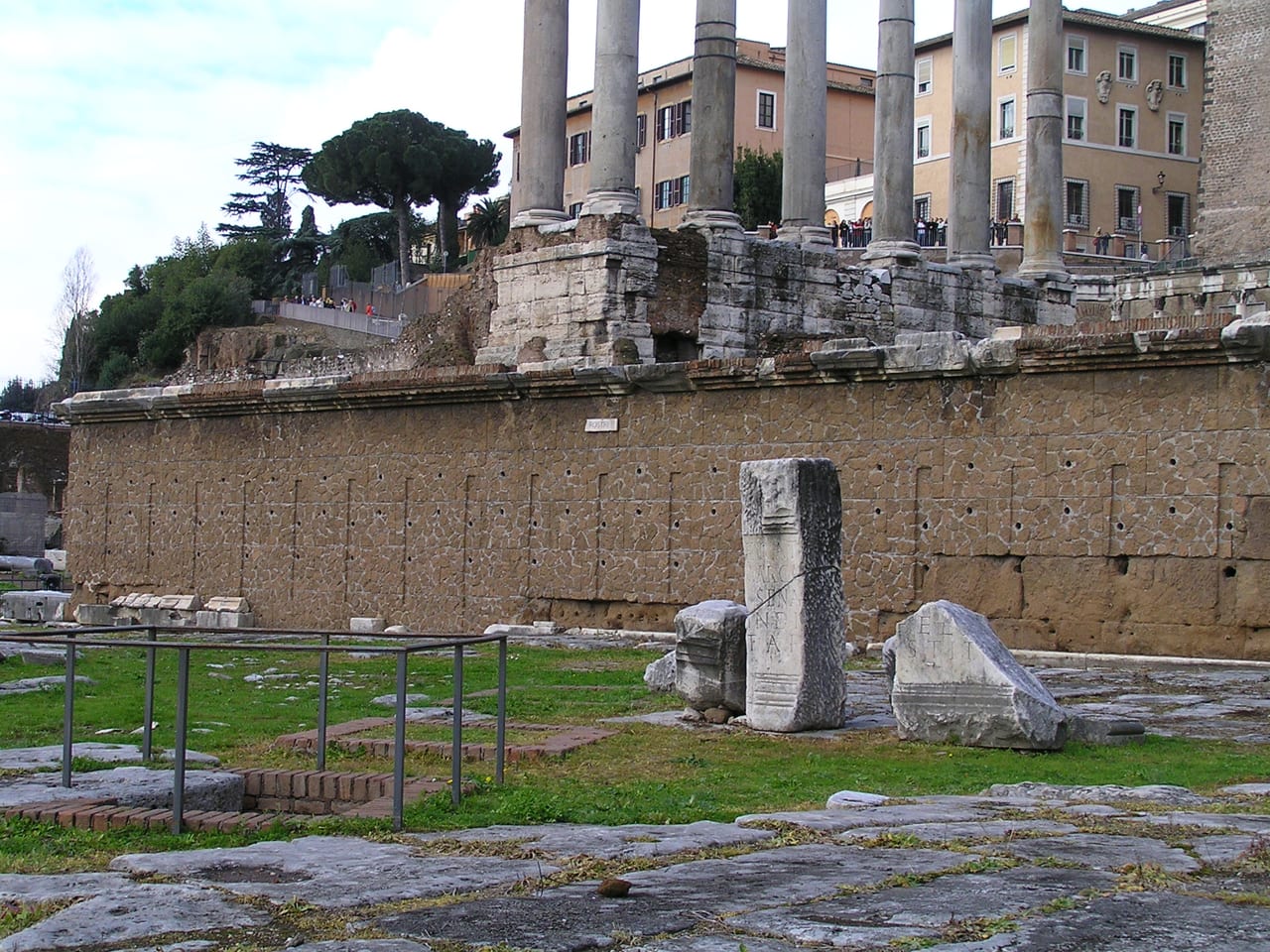
The Comitium’s earliest story lies between archaeology and legend. Accounts link Romulus and Servius Tullius with the organisation of the comitia, while descriptions of an Etruscan rite describe a sacred circular trench, or mundus, at Rome’s ritual centre. The Senate probably first met in an Etruscan temple associated with the Curia Hostilia, traditionally built or refurbished by Tullus Hostilius in the seventh century BC. A cippus inscribed around 450 BC records civic duties and is the earliest surviving document of the Roman state. The space accumulated Rome’s most resonant political monuments: the Rostra, the Graecostasis, the Columna Maenia and the Tabula Valeria. Sulla enlarged the curia in 80 BC, but Caesar twice reduced the Comitium, dismantling and realigning its buildings. Clodius’s cremation in 52 BC destroyed the Curia Hostilia, and Caesar later replaced it. Excavations beginning in 1898 revealed the Lapis Niger and more than 400 medieval cemetery burials; work from 1899 to 1903 established the site’s archaeological importance.
Ways to explore Comitium
Concentrate on the surviving travertine paving, the Lapis Niger and the curved boundary wall built over older tufa work. Consider the space in relation to the Curia Julia and the Rostra, then trace the positions of the Graecostasis and Columna Maenia along the forum edge. Observe how the open forecourt, raised speaking platforms and surrounding monuments created a carefully ordered setting for public ceremony, judgement and display.
Places to stay near Comitium

Live availability and prices from Stay22's partners, refreshed periodically and subject to change. Booking through these links may earn us a commission at no extra cost to you. See our privacy policy.
Cafés near Comitium
Cafés near Comitium loads as you scroll.
Attractions nearby
Attractions near Comitium loads as you scroll.
Cities nearby
Cities nearby loads as you scroll.
More in Rome
See more of Rome.
Find great cafés, places to stay and other interesting places to visit in Rome.