Monument · Rome
Column of Phocas
DirectionsErected in 608, the Column of Phocas was the final architectural addition to the Roman Forum after more than 1,300 years of construction.
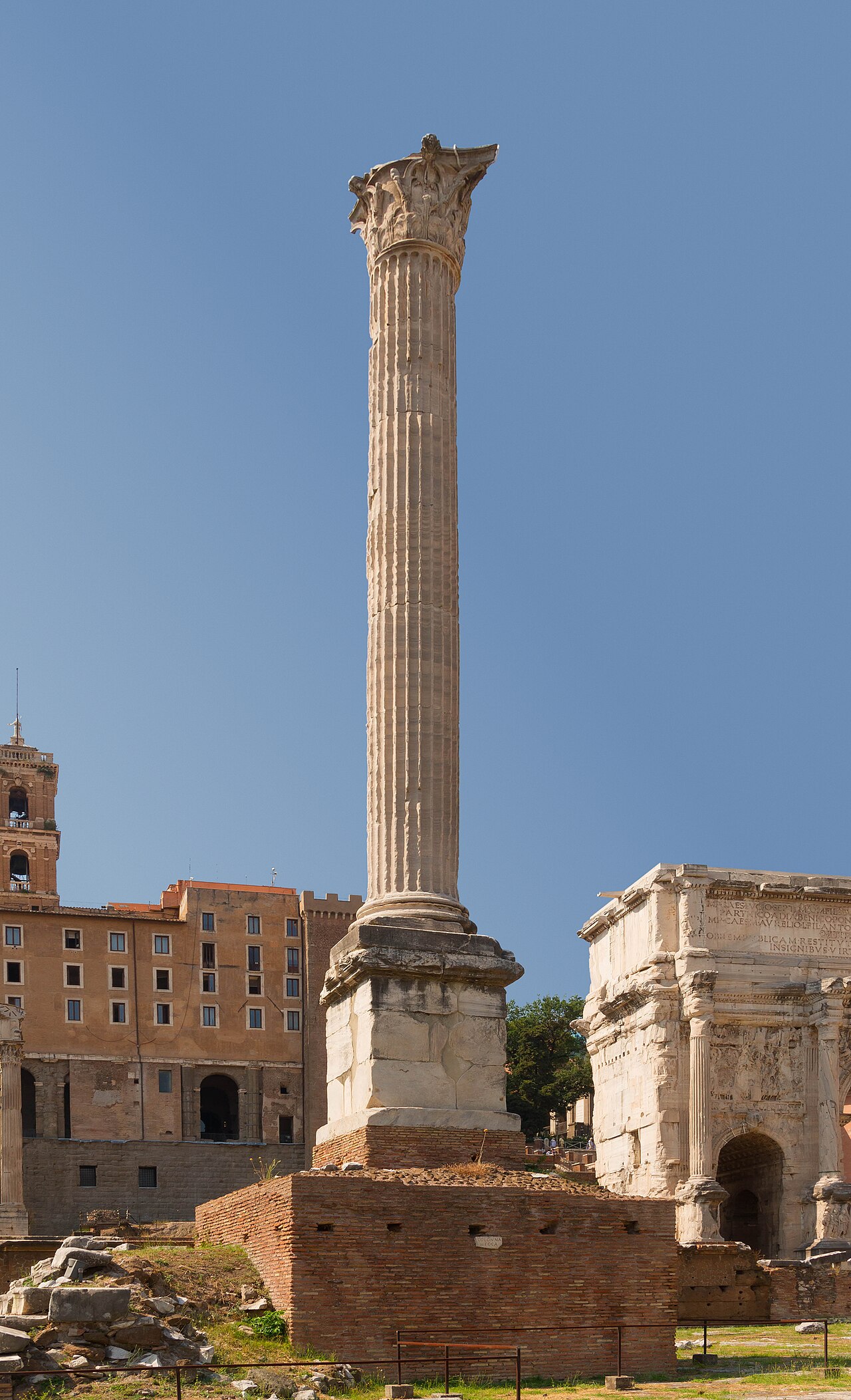
The monument was erected before the Rostra on 1 August 608, when Rome belonged to the Eastern Roman Empire following its reconquest from the Ostrogoths. It honoured Emperor Phocas, whose reign ended abruptly in October 610 when he was overthrown and killed; his statues were then toppled across the empire. The 13.6-metre fluted Corinthian column rises from a cubical white-marble socle. Stylistic evidence suggests the column itself was made in the second century for an unidentified structure, while the socle had previously supported a statue of Diocletian. Its earlier inscription was chiselled away to make room for the dedication to Phocas. Smaragdus, Exarch of Ravenna, commissioned a dazzling gilded statue of the emperor for the capital. This was probably an assertion of imperial authority over Rome, rather than simply an expression of papal gratitude, and also reflected Smaragdus’s personal debt to Phocas, who had restored him to power after exile. The base was buried by rising silt and debris until its discovery in 1813. By the eighteenth century, the column appeared in engravings by Giuseppe Vasi and Giambattista Piranesi; later excavation exposed the Augustan paving and its brick foundation.
At a glance
- Built
- 608
- Heritage
- yes
Ways to explore Column of Phocas
From the Rostra side, the column’s solitary vertical form can be read against the Forum’s ruins. The Latin dedication is visible on the white-marble base, while the fluting and Corinthian capital remain visible above. The marble socle can be distinguished from the square brick foundation beneath it; eighteenth-century views by Vasi and Piranesi provide a comparison.
Places to stay near Column of Phocas

Live availability and prices from Stay22's partners, refreshed periodically and subject to change. Booking through these links may earn us a commission at no extra cost to you. See our privacy policy.
Cafés near Column of Phocas
Cafés near Column of Phocas loads as you scroll.
Attractions nearby
Attractions near Column of Phocas loads as you scroll.
Cities nearby
Cities nearby loads as you scroll.
More in Rome
See more of Rome.
Find great cafés, places to stay and other interesting places to visit in Rome.