Church · Naples
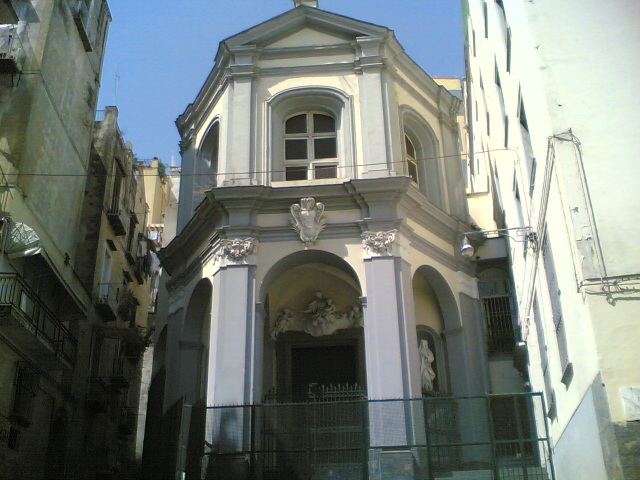
Its stucco portico, shaped as a semi-hexagon and threaded between narrow lanes, is an unusually theatrical late-Baroque threshold to this compact Neapolitan church.
Founded in 1568 by the Congrega dello Spirito Santo, Santa Maria del Rosario a Portamedina was completed with a cloister during the seventeenth century. Two major campaigns followed between 1724 and 1742; the latter restoration gave the complex its present late-Baroque character, with stucco redecorating both interior and exterior, probably through the intervention of Domenico Antonio Vaccaro and his school. The church is also known as Santa Giovanna d’Arco or Rosariello a Portamedina. Inside, a centralised plan places two chapels on each side of the nave, leading to a rectangular apsidal presbytery. Vaults cover the nave and chapels, while the church has no dome. The sixteenth-century cloister, enlarged in the following century, has a square central space bordered by three arcades on each side; its form was altered during a general refurbishment of the rooms in the twentieth century. In 1929 the Dominican conservatory passed to the Sisters of the Company of Mary, and in 1937 it was legally recognised as a school. From the mid-twentieth century, the complex was expanded and substantially altered.
Look for Antonio Sarnelli’s signed painting, “Saint Anthony Adoring the Child in Saint Joseph’s Arms, Surrounded by Saints Januarius and Michael,” the church’s most notable surviving artwork. Nearby, the convent is used for private educational purposes and cannot be visited.
Live availability and prices from Stay22's partners, refreshed periodically and subject to change. Booking through these links may earn us a commission at no extra cost to you. See our privacy policy.
More in Naples
Find great cafés, places to stay and other interesting places to visit in Naples.
